Monday, March 8, 2010

Fake front page brings paper Disney dollars, debate

By Alan Duke, CNN
March 5, 2010 6:47 p.m. EST

Los Angeles, California (CNN) -- At first glance of Friday's Los Angeles Times, you might think the Mad Hatter has taken over the newspaper.


Johnny Depp's colorful character in Disney's new film "Alice in Wonderland" dominates a faked front page, which includes the paper's traditional flag and two stories that appeared in the paper last month.

Los Angeles Times spokesman John Conroy said the "cover-wrap" was an "unusual opportunity to stretch the usual boundaries and design an innovative ad designed to create buzz."

Roy Peter Clark, a senior journalism scholar at the Poynter Institute, said tough economic times and lower ads sales have forced newspapers to tear down the ethics wall that separated a paper's front page from advertisers.

"The wall became in recent years a fence, but the Los Angeles Times has created a swinging gate," Clark said.

"What offends my traditional sensibilities is the notion that you would be willing to deceive the reader into thinking that this was the actual front page," Clark said.

Although Conroy said readers would not be confused by the fake front, several journalists in CNN's Los Angeles bureau did not immediately realize that the real front page was inside.

A Times reader who works for a movie marketing company in Hollywood said he felt deceived by the ad. He asked not to be identified because his company, which was not involved in the Disney campaign, deals with the newspaper.

"We propose these kinds of ads all the time but have never gotten them approved," he said. "I don't always agree with what we do."

He estimated that the ad would cost "well over $100,000."

Conroy would not disclose the price, but he said, "Our front page section is our most valued real estate. The ad was priced accordingly."

The use of real newspaper stories, published previously in the newspaper, to make the ad appear to be a real front page is another issue, Clark said.

"I'm particularly nervous about them running fake stories that are really real stories," he said. "That seems like a misappropriation of the journalism in the newspaper."

An online search revealed that the article on the left column -- headlined "To take reins on health proposal" -- was a slightly altered version of a story written by Tribune Co. Washington reporter Noam Levey. It was published February 18.

The second article, appearing on the right column of the Disney ad, was headlined "Major Afghan Figure Caught." The original story was published February 19, with the bylines of Times foreign correspondent Laura King and Moscow bureau chief Alex Rodriguez.

"If I had written one of those stories, I would be pissed," Clark said.

CNN has received no response from e-mails and calls to the three journalists.

Although they may not be pleased with their work being used in a movie ad -- without the byline -- they have jobs while many of their co-workers have been laid off.

The Tribune Publishing Co., the paper's parent, has ordered several rounds of staff cuts at its newspapers and bureau in recent years. Some have left in protest of changes in editorial practices aimed at boosting revenue, Clark said.

"There's been one editor after another that's walked out the door because they didn't want to cave in to pressure from the top to do the wrong thing," Clark said.

What he might have objected to five years ago, he could now accept it helps papers survive, Clark said. But not if it confuses editorial content with ads, he said.

"Every time I see a big ad in my local newspaper I send up a little cheer," he said.

When HBO paid the newspaper for a wrap-around ad last summer, for the vampire series "True Blood," it was not mixed with the flag or editorial content.

The Los Angeles Times drew criticism in April when it sold NBC the right column of its front page, where a lead story is normally placed. The network used the space to advertise the debut of its "Southland" series.

(Courtesy CNN.com)


Wednesday, March 3, 2010

Noooo, Don't Take My Colbert from Hulu!

Aw man, why do I have to get this crap news on my birthday? Click the title to go to the article...

Hulu Loses Viacom, 'Stewart' and 'Colbert'
Fast-Growing Video Site Fails to Reach Extension With Parent of Popular Comedy Central Shows


I can't stay up til 11pm to watch the shows when they're actually on (insert old lady joke here), so I usually watch them in the morning on Hulu before I head into work. What will I do now? Nothing goes with coffee like Colbert....


(Courtesy of AdAge)

Tuesday, March 2, 2010

Targeting "Life Stages" vs. Demographics in Advertising

It's becoming harder and harder to segment the population for targeted advertising based on traditional demographics such as age, gender, and location. There are just too many variables in the world nowadays that it makes sense to look more toward behaviors and stages in life as more appropriate indicators of possible buying decisions.

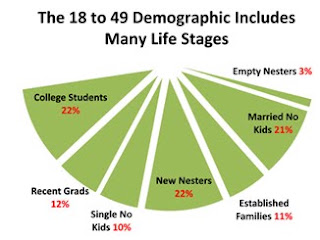
According to a recent study conducted by the USC Entertainment Technology Center, Hallmark Channel, and E-Poll Market Research, people are more affected by their 'life stage' than other factors:
The wealth of information captured in the survey reveals that individuals in different life stages can have very similar demographic profiles but different attitudes and media usage. For example, the 18 – 49 demographic group familiar to TV and advertising executives is made up of people in seven different stages, with College Students, New Nesters and Married No Kids comprising nearly equal proportions. Three of the life stages have a median age of 37 or 38. Yet when examining behavior, the life stages are distinct and exhibit clear differences.


(Courtesy of AdWeek and E-Poll)

Wednesday, February 24, 2010

Yahoo! Wants to Take Over the Interwebs...

Well, maybe not really, but it sounds like they're trying.

What they have done is inked a new deal with Twitter that will allow Yahoo! users to see real-time tweets on all Yahoo! properties, and in turn allow Twitter users to tweet through their Yahoo! accounts.

This comes shortly after Yahoo! partnered with Microsoft last year to use the bing technology for internet searches.

Sounds like a well-planned interweb coup if you ask me....

(Read the full article here)


(Courtesy of CNN.com)

Friday, January 29, 2010

Mancrunch Swears This Isn't a Super Bowl Stunt

From Ad Age:

Mancrunch's attempt to land a Super Bowl spot has kicked up a ruckus online, where commenters upset about CBS's decision to air an anti-abortion ad starring football star Tim Tebow are howling about the network's alleged double standards because it won't air a spot showing two men kissing.

Here's the ad, enjoy! You might not see it on national television...


Read the full article from Ad Age here.


(Courtesy of
adage.com)

Thursday, January 21, 2010

Brown's Massachusetts Win Could Mean Higher 2010 Ad Spending

Tuesday's special election victory for Scott Brown has put the spotlight squarely on our little Northeastern state of Massachusetts. Considering the immediate political implications that come along with Brown's win, we're also looking at possible increased TV ad spending this year for the upcoming midterm elections in November.

As I posted a couple months ago, political advertising was already set to surge this year, but Tuesday's big win for the GOP will undoubtedly fuel additional spending.

Here's the article from
Ad Age:

WASHINGTON (AdAge.com) -- Republican Scott Brown's win of a Massachusetts Senate seat could turn out to be a boon for media companies, increasing spending on political advertising this year from the $2.8 billion originally expected.

Together with announced retirements by some key Democrats, the outcome over filling Sen. Ted Kennedy's seat in yesterday's special election in Massachusetts offers an unmistakable signal to both parties that they are going to have to weigh in early to start courting voters for this year's November midterm elections.

There were signals from all sides that the election could increase the number of challengers running, which in turn would boost fundraising activities and, ultimately, lift ad spending.

The spending could increase even more if the U.S. Supreme Court frees businesses to spend on political advertising even in the last throws of a race. An important high court ruling could come down as soon as tomorrow.

Normally, off-year elections focus more on local, rather than national issues and the extent of media spending depends on how many primary races take place, where they are (big states have far more expensive media markets), how many incumbents are running and, finally, the number of major local referenda issues. Generally there isn't much national advertising. Political parties and interest groups buy markets in states with races.

This year Evan Tracey, president of TNS Media Intelligence's Campaign Media Analysis Group, a company that tracks political ad spending, was already predicting the combination of open gubernatorial races in Illinois, New York, California and elsewhere would hit the $2.8 billion spent in 2008, when the presidential race bolstered spending.

Mr. Tracey today said spending this time could now exceed that amount. The final figure, however, isn't yet clear -- in part because the economy and the Supreme Court decision could still affect the total.


Still, the Massachusetts race raised the stakes, he said.

"Anybody can win anywhere. There is no such thing as a safe incumbent any more," he said.

The Massachusetts results also could put more of a national debate in play, potentially benefiting cable news channels. It could also prompt the Republican and Democratic parties and advocacy groups to step up their local spending to make arguments about health care, the economy and other issues more typical to a presidential election year.

Today spokesmen for some cable companies and the Television Bureau of Advertising acknowledged they see the impact as potentially boosting political ad spending.

"It increases the importance of targeting your voters," said Tim Kay, director of political strategy for NCC, the national individual spot sales arm of major local cable providers. He pointed to independent voters, who were a major factor in the Massachusetts vote.

Greg D'Alba, CNN's exec VP-chief operating officer-sales and marketing, said advertising could be up for two reasons. First there could be more political advertising, period. Secondly, the results also signal more interest in politics this year and that could generate more corporate advertising in support of coverage.

"It's created another stellar political cycle," he said. "Last night's election supports our forecast that the midterm elections are going to be really important."

He said that he expected the political parties would do a national overlay of their messages to buttress local spending.

Jack Poor, VP-marketing for the Television Bureau of Advertising, said it sees the results as a fundraising boon to political parties, individual candidates and interest groups -- especially on the Republican side. That, in turn, will fuel ad spending on both sides.

"All that was missing [from the election races this year] was the full coffers," he said.


(Courtesy AdAge.com)

Thursday, January 14, 2010

Follow-Up: Bar Codes in Advertising

So I'm flipping through my February 2010 issue of Website Magazine today and happened to notice barcodes in a few of the ads, such as this one:

See it in the bottom left-hand corner?


If memory serves me right, I had posted about this same barcode technology last year when they were appearing in the National Post of Canada.

Pretty cool way for people with smartphones to be able to connect immediately with print advertising...

(Courtesy Website Magazine)


Monday, January 11, 2010

How the Hamsters Saved Christmas: Zhu Zhu Pets Recharge Battery Category

So I get a call from my dad a couple weeks before Christmas that went like this:

Dad: Does your cousin's iPod run on AA batteries?
Me: No, sorry Dad.
Dad: What about his cell phone?
Me: Nope.
Dad: Game Boy? CD player? Anything?

Me: No, why?
Dad: I just bought 100 AA batteries at Costco for Christmas presents. I'm not sure what to do with them now...

Poor Dad, alkaline batteries used to be his go-to gift and now he's lost in a sea of rechargeables and lithium ion. If you've found yourself in a similar predicament recently, read on:
Loading up on alkaline batteries was once a familiar rite of holiday shopping for parents, but the category has been in a funk since well before the recession as traditional battery-operated toys and gadgets lost cachet to smartphones, laptops, iPods and other portable devices using different power sources.

But a funny thing happened this holiday season: Alkaline batteries had their best quarter for volume growth in at least three years and their first positive holiday quarter in terms of volume in four years. Zhu Zhu pets, one of the biggest breakout toy hits in years, may deserve the credit, though a round of savage price-cutting also played a role.

Don't worry, there's hope for you next year, Pops. :)


(Courtesy of AdAge.com)

Wednesday, January 6, 2010

DirecTV, ESPN, & Discovery to Launch 3D TV Channels

I still don't want to see Avatar in 3D because the blue hybrid people-aliens kinda freak me out, but put anything else in 3D and I'll be there with bells (and my 3D glasses) on.

Coming off last week's news that
DirecTV is planning to launch a HD 3D channel early this year, both ESPN and Discovery Networks have announced they are planning to launch 3D channels of their own:
The Disney owned sports operator is set to introduce ESPN 3D in June, launching with the airing of the first World Cup soccer games on June 11. The channel will air 85 live sporting events over the year, but will go dark when there is no event on.
World Cup replays, goal celebrations, and hard tackles in 3D? AWESOME.
Discovery, meanwhile, has launched a joint venture with technology companies Sony and Imax, to launch a 3D channel in 2011. Although, it hasn't announced what content it will air in 3D, the channel will be a 24 hour channel.

The only possible drawback? According to the article about DirecTV's HD plans:
If accurate, the newly available content for the firm’s subs would require both a 3D-equipped HD set (and the requisite glasses) in order to see the light, as it were. One Web site, HD Guru, which originated the story citing its own sources, said DirecTV will announce its 3D plans at CES.
You know, I'm tempted to be skeptical about this 3D channel business, simply because it seems untested and unnecessarily expensive to buy a completely new television to view only one or two channels.

But then think about early HD programming - it was only a couple channels and required a new TV - and how far that has come along in the last few years. Surely there are innovators out there who will jump on the 3D wagon and extoll its virtues to the rest of us who will slowly follow suit. Is this going to be another change that's going to revolutionize the way we watch television?


(Courtesy of TBIvision.com, tvtechnology.com, & HDGuru.com)

Monday, January 4, 2010

Seven Advertising Insights for the New Year

Happy New Year! Dana Severson's seven advertising insights (below) are absolutely worth sharing and paying attention to in the new year. (I know, I know, this was written in December 2009, however it still notes some important points and things to consider for 2010):

1. Social networking is only a good idea if you are going to be social. Don't get me wrong, I'm not a social media "guru" by any stretch of my imagination. However, it's obvious to anyone who has a Facebook account that unless you're having conversations, you're not being social.

2. Just because newspapers are failing doesn't mean that print media is dead. Numerous studies have proven it. That said, forget the research. If you want real proof that print media is still alive, just look at the collection of magazines on coffee tables and in bathrooms at your next get-together. Or, better yet, consider your own relationship with your favorite magazine. Magazines are shuttering because advertisers are spending less. It's not, I repeat, NOT because readers stopped reading them.

3. For the reasons I just mentioned, do not eliminate print from your advertising plans. I'm generalizing here, but for the most part, rates are cheaper and there's less competition for the reader's attention between the covers. In other words, your ROI is going to be much greater.


4. The over-analysis of online advertising is detrimental to the concept of branding. Keep in mind, the measurement of success from your online advertising efforts doesn't always have to come in the form of clicks. Don't worry Mr. Client, it's not your fault, you've been misled. Ad networks have trained you to believe that the only value in online advertising is conversions. This is not true.

5. With that in mind, banner advertising is becoming increasing less effective (both in terms of brand exposure and conversions). Focus on online campaigns that engage, entertain and inform. In other words, branded content is an idea you should be exploring. And, by branded content, I don't mean sponsored blog posts. Those are nothing more than a banner ad made of words. Rather, think of engaging/entertaining the reader first, advertising second.

6. For once, green-light the third concept. You know, the one that's outside your comfort zone. This is the campaign that will more than likely drive the greatest results. Why? Because we know what we are doing and we just want you to trust our judgment on this -- just once. You won't be sorry.

7. And lastly, for god's sake, NO MORE BUDGET CUTS. OK, that was just some wishful thinking, but please do consider it.


(Courtesy of AdAge)